The First Spark
Some minds bend instead of breaking.
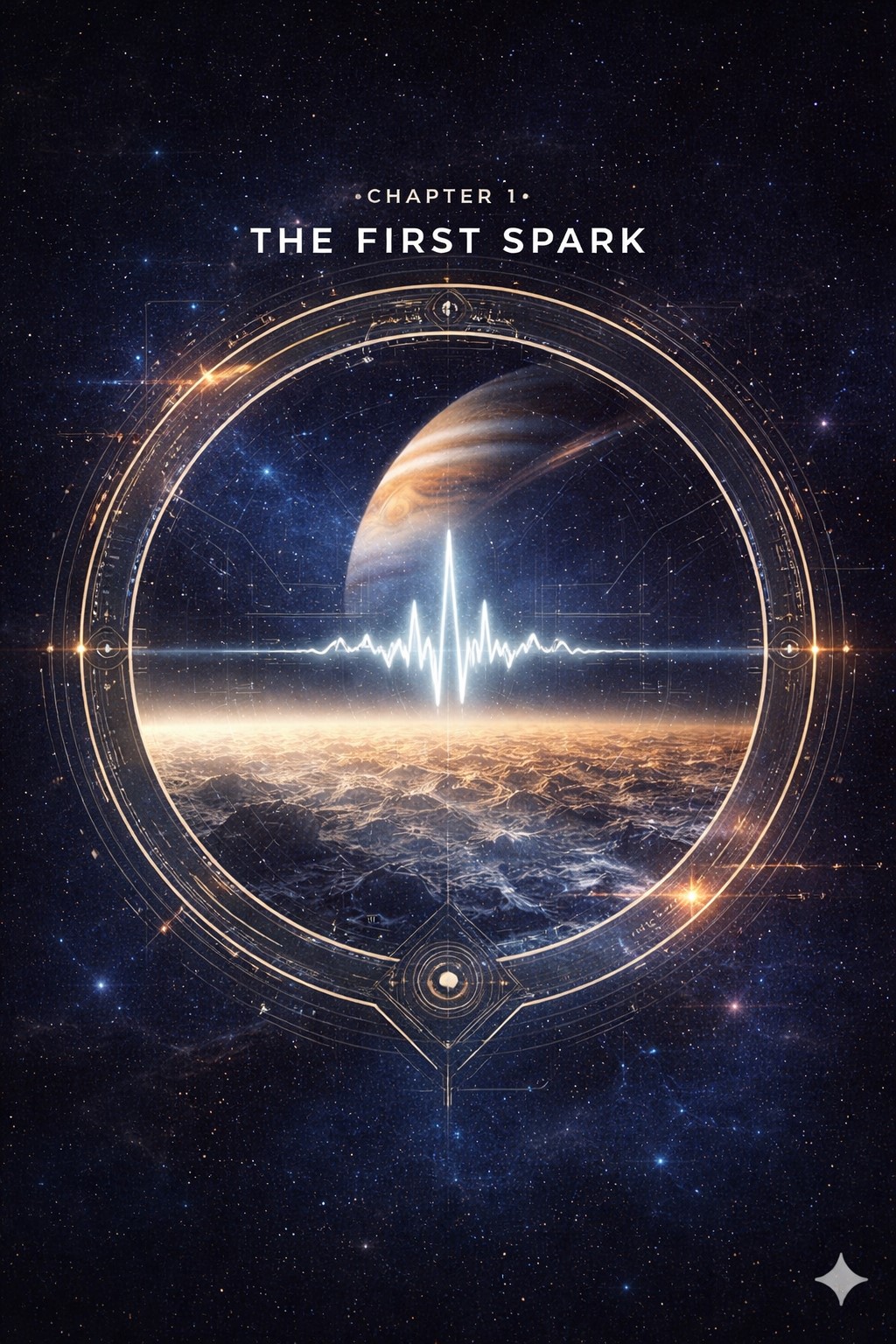
Timestamp: T + 52 days post-Sargasso Collapse
Location: Iapetus Relay Station, Encrypted Holo-Channel
The relay array's calibration pulse thrummed through the station's framework—a low-frequency rhythm Taryn had learned to ignore months ago. Tonight, she couldn't.
She had slept four hours in the past two days.
Iapetus was not a colony. It was an outpost, and barely that. The relay station had been built into the bright trailing hemisphere, where the albedo was high and the thermal conditions stable enough for long-term equipment operation. The dark leading hemisphere—Cassini Regio, as the astronomers called it, a smear of reddish black that absorbed light rather than reflected it—was visible through the viewport, a permanent reminder that the moon kept one face to Saturn and one to the void. The boundary between the two hemispheres ran across the surface like a scar that had never healed.
Taryn lived on the bright side. Everyone did. The dark side was considered bad luck, or bad science, depending on who you asked.
The station itself was a cluster of prefabricated habitat modules, anchored to the ice by thermal piles that had to be recalibrated every three months—or risk shearing loose. The crew complement was twelve, down from thirty-two before the systems degradation began. Most of the empty modules had been sealed off, their environmental systems running on standby, their corridors dark except for the occasional flicker of an automated diagnostic light cycling through its routine. Taryn had walked those empty corridors once a week for the first three months, checking for frost heave, checking for stress fractures, checking for anything that might explain why the station's systems kept drifting out of alignment. She had found nothing. The logs were clean—too clean. Someone had scrubbed them before the failures began, or the failures were generating their own cover.
She had stopped walking the empty corridors after month four. There was no point. The station was degrading in ways the diagnostics couldn't explain, and no amount of visual inspection was going to reveal what the sensors refused to register.
She'd read Bostrom's simulation argument years ago. She remembered thinking, tongue in cheek, that if the universe was a simulation, the only thing that mattered was whether the programmers were competent. Now she wondered if the Glyph was what happened when a simulation's error-correction protocols learned to rewrite the sims.
The remaining crew was essential personnel: two comms technicians, a life-support engineer, a medical officer who doubled as the station's cook, and a handful of general maintenance staff. Taryn was the only one with neural architecture training. The only one who could read the deeper system logs. The only one, she suspected, who had been told the full story of why the station was failing. If anyone had been told. She had filed three reports. None had been acknowledged.
The days were structured by the calibration cycle: four-hour intervals between pulse adjustments, with each one logged and verified against the Titan baseline. The work was repetitive, exacting, and pointless—the system was drifting regardless of how carefully she calibrated it, and no one at TCA headquarters seemed interested in her findings. She ate her meals alone in the mess hall, reading technical briefs that were weeks out of date. She slept in four-hour increments, interrupted by the chime of her console alerting her to another micro-fluctuation in the phase-lock. She had stopped dreaming of Ganymede months ago. Now she dreamed of grids.
The isolation was not total—the Pulse-Sync kept her connected to the rest of the system, with the holo-channel available for priority communications—but it was close. The nearest human being beyond the station's walls was on Titan, millions of kilometers away. Help, if it ever came, would take days. She had accepted that when she took the posting. Knowing and feeling were different things.
Saturn hung in the viewport most days, its rings like a faint silver scratch across the black. The planet's magnetosphere interacted with Iapetus's surface in ways that produced occasional auroral effects—faint curtains of light that flickered along the terminator between the bright and dark hemispheres. Taryn had watched them on sleepless nights, telling herself they were beautiful. They were beautiful. But they were also evidence of forces she couldn't control, and beauty had never been enough to quiet the part of her mind that needed systems to make sense.
The ridge was visible from the station's observation deck: the equatorial wall that ran for thirteen hundred kilometers across Cassini Regio. Twenty kilometers wide, thirteen kilometers high, one of the tallest mountain ranges in the solar system, and no one had ever satisfactorily explained how it formed.
Taryn had read the theories—remnant of an ancient oblate shape, collapse of a ring system, icy material welling from the interior—and found them all unsatisfying. The ridge was there. It had been there for billions of years. It didn't need to explain itself. She respected that.
She pressed her palm against the viewport glass, feeling the cold bite into her skin. The metal floor vibrated with the calibration pulse. The console behind her chimed: another micro-fluctuation. Another log entry. Another report no one would read.
Her neural overlay flagged elevated heart rate, elevated cortisol, and a more worrying alert: Category Three cognitive deviation, logged only hours earlier in Cold Storage Bay 7.

The report seemed trivial in scale and devastating in implication: a technician, unable to recall a sector designation, was later found tracing angular patterns into the frost. The incident was flagged "Janus Review Pending." Taryn opened it.
The Janus Initiative answered to the Terran Cognitive Authority—the Federation's cognitive-security arm. In effect, the TCA answered to no one but itself. Taryn had never needed to understand the hierarchy before. Now she was inside it.
JANUS FIELD REPORT ADDENDUM – INCIDENT 7-Alpha
LOCATION: Iapetus Relay Station, Cold Storage Bay 7
Marcus wiped his hands on his apron and stepped through the airlock. Twenty-three years he'd been feeding station crews. Aisle C-47 held the flash-frozen salmon.
But as his boots echoed on the metal grating, Marcus paused.
The designation C-47 should have been automatic—a simple label. Instead, something else flickered in his mind. Not letters and numbers, but angular, twisting shapes that writhed when he tried to focus.
He blinked hard.
‘C-47,’ he said aloud, his breath misting.
But the shapes overwhelmed the simple designation, growing brighter behind his eyes. A wave of dizziness forced him to grab the nearest support rail.
His vision blurred. The cooling units thrummed around him, and the metal rail felt like the only solid thing left. He slumped against the wall and slid to the deck.
His hands trembled as he pulled out his work pad. He found the entry he needed.
Tuesday Prep – Bay 7, Aisle C-47 – Salmon, 2.3kg
“C-47,” he read aloud, and the designation snapped back into place. “Jesus, how could I forget something so basic?”
He rubbed his temples.
Insomnia, he told himself.
But as he stood, he kept whispering the code—“C-47, C-47”—and the cadence matched the angular shapes exactly.
He headed toward the aisle, the designation now clear. He felt momentarily safe, his system corrected.
Hours later, a fellow technician found Marcus standing by the rail, his index finger tracing the same complex, angular shapes into a thin film of frost on the wall. They looked like machine diagrams—fractal and cold. The shapes pulsed in the frost, as if alive. When the technician blinked, they lingered in his vision—a high-pitched whine humming at the edge of his hearing, like a tuning fork struck against his skull.
“Marcus? You all right?”
He startled, jerking his hand back and wiping the wall furiously.
“It’s nothing,” Marcus muttered, rubbing the back of his neck, the gesture betraying his unease. “Condensation.”
The technician backed away, unsettled. He had glimpsed the intricate, jagged spiral Marcus was sketching, and for a split second, the pattern had snagged on his own visual cortex, beginning to repeat a subtle, high-pitched whine inside his head.
He immediately forced his thoughts to his wife and children—a containment reflex drilled into every station briefing—and snapped his focus back to the metal grating.
The embryonic loop vanished.
The incident was flagged for Janus review. Days later, Marcus reported dreams of gridlines pulsing in the dark, each night carving deeper into his sleep.
He stopped reporting after day seven.
Not because the dreams had ended.
Because he’d started liking them.
---
She read on, her fatigue forgotten.
By the time she reached the final line, she couldn't say what disturbed her more—the technician's symptoms, or the fact that they matched nothing in her training.
This wasn't a system failure.
It wasn't a structural fault.
It was something she lacked the vocabulary to name.
The patterns Marcus traced weren't random. She could see that much. They were recursive—fractal shapes folding into themselves with a logic she felt at the edge of comprehension but couldn't grasp. She had seen structural failures, cascade collapses, the arithmetic of triage. She had never seen a man start liking his own nightmares.
Her fingers found the scar on her wrist.
Ganymede.
The grid failure.
Seven hundred saved by choosing which systems to let die; three hundred lost when the air stopped flowing in the outer rings. She still heard the sector designations in her sleep: G-7. H-12.
Taryn glanced at the small glass cylinder mounted beside her console: the Pulse-Sync monitor, slaved to the Iapetus Relay Tank deep in the station's vault. For fifty years the paired tanks had reduced effective light-lag across the colonies to something most users no longer perceived.
Not eliminated.
Reduced.
Disguised.
Disciplined into obedience.
The Pulse-Sync carried only compressed state changes—tiny coded biases across paired relay tanks—just enough for a local relay core to rebuild meaning from fragments.
The system did not send voices whole across space. It sent coded pulses through paired relay tanks—brief, compressed bursts too narrow for continuous speech, too unstable for high-volume data, but enough for local systems to reconstruct a voice, an image, an instruction. The work was handled by dedicated relay AIs—narrow, old, incurious systems built for one purpose only.
Hold the channel.
Validate the pulse.
Rebuild the signal.
Close the aperture before drift became failure.
Conversation only felt continuous because most of it was prediction. The relay sent verified anchor pulses; the local system filled the gaps, corrected the face, stabilized the voice, and quietly concealed the missing milliseconds.
The reconstruction was not memory alone. Each anchor pulse carried fresh deltas: a change in tone, a movement of the mouth, the tilt of a head, and the pendant at her throat. IRC-7 guessed the ordinary parts. The important changes were real.
The Iapetus relay core—designation IRC-7, though everyone just called it the Core—had been running this protocol for twenty-three years without a major fault. It did not learn. It did not adapt. It simply executed.
Most people never thought about it. They saw a face appear in a holo-feed and forgot that the face had been rebuilt from fragments.
The small monitor beside her shimmered violet, its excitation state phase-locked to the Titan tank. The indicator line sat steady.
Too steady.
Her untouched meal sat cold beside the console. The priority channel pulsed, insistent.
She pressed her palm against the console, grounding herself. The metal was cold enough to sting, familiar in a way that almost felt like control.
The holo-feed stabilized.
The woman on screen had sharp angles, dark hair pulled tight, and a pendant at her throat that caught the light. Not jewelry. Something heavier. Her eyes missed nothing.
Taryn's eyes flicked to the small Coherence Meter in the terminal's corner. Its needle sat steady in the green.
Iapetus lock stable.
“Dr. Mara Ross. You answered quickly, Ms. Gash,” said Ross.
“The Pulse-Sync was already humming. I assumed someone was dying,” said Taryn.
“I had to authorize a priority bypass on the Iapetus-Titan link just to get through the queue,” said Ross.
“The link is usually reserved for Council traffic. My terminal had to reroute the local hub to find your frequency,” Taryn said.
She knew IRC-7 was sorting the transmission through millions of mundane packets—logistics reports, personal pings, station telemetry—cutting the priority pulse into clean fragments and rebuilding it with mechanical patience. The system did not understand urgency. It merely ranked it.
“Time is a factor. You’re familiar with the Sargasso Collapse?”
The name hit like a blade.
“Everyone is.”
Taryn looked at the clarity of the image. Even across the distance between Iapetus and wherever Ross was transmitting from, the feed showed no jitter, no compression noise.
Engineers called it the “Mirror Effect”: the tanks did not transmit the picture whole. They sent verified fragments through the Pulse-Sync, while local systems rebuilt the image so cleanly that users forgot reconstruction was happening.
She watched the needle on the stability gauge.
It didn’t even flicker.
For a fraction of a second, a faint amber echo ghosted behind the needle—so brief the phase lock corrected it before the monitoring software could register the drift. A mismatch between prediction and reality, erased before it existed.
Taryn frowned.
The log buffer remained empty.
The system hadn’t recorded it.
Which meant either nothing had happened—
or the correction had been faster than observation.
Ross’s fingers closed around the pendant briefly before dropping away. Taryn recognized that gesture. She’d seen it in people touching keepsakes, luck charms.
Whatever that pendant meant to Ross, it wasn’t decorative.
“My sister died there.” A pause. “Chesca. She led the research team.”
“I’m sorry.”
“She thought her training would protect her,” Ross said, thumb brushing the pendant. “It gave the contagion more room. We quantify that pressure now as Recursive Volume. A standard human mind can only sustain so many recursive layers before it redlines. The Glyph exceeds that limit.”
Taryn’s hand stilled on the console.
“The Glyph.”
“The Sargasso Collapse wasn’t a system failure,” Ross said. “It was a cognitive contagion—a recursive symbolic pattern that propagates through the neural mesh. The mesh wasn’t just amplifying it. It was translating it—turning cognitive patterns into electromagnetic signals, then broadcasting them. That’s why it spread so fast. The system thought it was helping.”
Taryn said nothing.
The word Glyph meant nothing to her yet—but the description of a system that amplified the very failure it was designed to prevent felt like something she should have recognized. She thought of the relay array’s degradation, the logs that were too clean, the empty habitat modules.
She thought of Marcus, tracing patterns in the frost.
“The Council loves the word Sargasso,” said Taryn, her voice flat. “It makes three thousand people dying in their own skulls sound like a drift of seaweed. It’s a pretty name for a massacre.”
“It’s also quarantine,” said Ross. “If people follow the names, they follow the logs. If they follow the logs, the resonance starts again.”
“Quarantine,” Taryn repeated.
The word felt clinical, like the edge of a scalpel.
“You’ve turned the truth into a biohazard,” said Taryn quietly.
“We had to,” said Ross. “We’re not hiding locations. We’re starving a resonance. In this century, ignorance can be an immune response.”
Taryn flexed her fingers. Her neural implants hummed quietly. Usually they felt like support.
Today they felt like an invitation.
If memory itself had become a vector, how much of her own mind had already been renamed just to keep functioning?
She thought of her brother Elias—his death six years ago, the creative augmentation loop that had trapped him in an infinite fractal of sound. The official report called it a localized neural spike. Taryn had never believed that. She had watched his mind consume itself, and she had called it something else in the privacy of her own thoughts.
Now Ross was giving her a word for it.
Taryn looked back at the screen, her cynicism replaced by a cold, calculating focus.
“You’re building a wall, aren’t you? Something big enough to need Titan’s infrastructure. Something big enough to need me.”
“I want you to help us understand why the wall isn’t working,” said Ross.
“The Janus Project needs someone who’s seen what happens when safeguards fail,” Ross continued. “Someone who’s made hard choices under pressure. Someone who survived.”
Taryn felt the room tighten around her.
She studied Ross’s face, hunting for the hook—some manipulative angle, some coercive undertone she could use to justify pushing back.
But there was none.
Only grief worn thin.
The honesty unsettled her more than manipulation would have.
“I heard about the research team,” said Taryn quietly. “All of them were contaminated?”
“All of them,” said Ross. “But Chesca… she tried to document her own deterioration. Thought her training could help us understand the mechanism.” Her voice hardened. “It just gave the contagion more pathways to explore.”
She tapped her console. A hologram flickered to life: Chesca’s final sketch—a spiral scrawled in blood, labeled “the new constellation.”
“My sister called the Glyph beautiful in her last coherent transmission.”
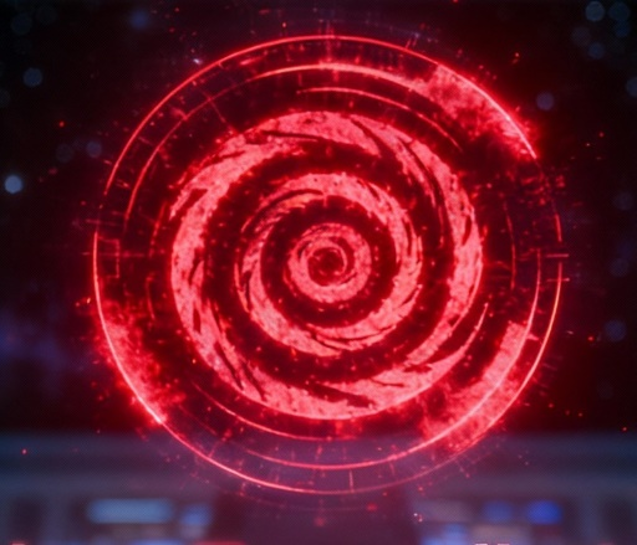
“A position opened on Titan,” said Ross. “Cognitive Systems Division needs someone with your background—neural architecture, but also field experience. Someone who’s seen systems fail in real time.”
“You want me because of Ganymede,” Taryn said. “Seven hundred saved. Three hundred lost. That’s not resilience, Dr. Ross. That’s triage.”
“I want you because you survived it.” Ross leaned forward slightly. “When three stations went dark, you kept thinking. Eighteen hours without sleep, rerouting the grid until rescue arrived. You didn’t freeze.”
“No.” Taryn’s jaw tightened. “I just chose who died.”
A pause.
Static rippled through the holo-feed—soft, almost organic.
Taryn frowned at her console.
“Is someone else on this channel?”
“Just reconstruction artifacts,” Ross said, too quickly.
“Titan’s a punishment post,” Taryn said. “What aren’t you telling me?”
“You’re already in the Saturnian system,” Ross said. “Iapetus. Six months into an investigation that’s going nowhere. Your reports aren’t being acknowledged because the TCA has bigger problems than relay degradation. And you’re the only engineer with your qualifications within transfer distance of Titan.”
Taryn stared at her.
“You’ve been tracking my posting.”
“I’ve been tracking everyone who might be useful.” Ross’s expression didn’t change. “You’re available. You’re qualified. And you’re close.”
“And why would I leave Iapetus for Titan?”
Ross’s mouth twitched.
“Because on Iapetus, you live in a half-abandoned relay station where the walls are too clean and the crew keeps getting rotated out for reasons no one explains. On Titan, at least you can step outside in a suit. See the haze burn gold. Watch Saturn ghost through it. Feel methane rain ticking against your visor. Die of something interesting for a change.”
Taryn stared at her.
“That was a joke,” Ross said.
“Was it?”
Ross didn’t answer.
Her thumb found her pendant again.
“The work is classified. But the risk…” She exhaled. “The risk is what happened to Chesca happening to others. To populations. I study how thoughts kill people. I’m asking you to help prevent it.”
Ross’s voice carried a calculated warmth.
“I’ve watched the recordings, Taryn. Hour twelve, when you had to choose between the residential and industrial sectors. You didn’t hesitate. That kind of decisive clarity under pressure—it’s exactly what cognitive contagion attacks first. Your strength could become your vulnerability.”
“And three hundred people suffocated in the outer rings because the air stopped flowing,” said Taryn, her voice flat. “My implants kept me focused during Ganymede—eighteen hours without sleep, rerouting the grid. But what if they’re why I see those faces every night? What if they’re already breaking me?”
“Your implants act as recursive stabilizers,” Ross said. “They let you hold more observation-load than most people. That may be why you survived Ganymede. But every gain in cognitive altitude comes with risk.”
“Would you rather all thousand had died?” asked Ross. “No enhancement is glyph-proof. Your neural implants—Europa-standard, yes? Chesca’s were state-of-the-art, and they turned her mind into a labyrinth for the contagion. That’s why we need someone who knows what it feels like to live with fragility in their own systems.”
A long silence followed.
Taryn returned to her seat, her movements deliberate.
“What’s really on Titan?”
“A prototype,” said Ross. “A contained environment where we observe the Glyph’s effect on a stabilized consciousness and try to build resistance. Corvus is attempting something no one else has managed: braiding human memory with machine logic to create a recursive system that doesn’t collapse.”
“Chesca kept a research journal,” said Ross. “Even as the Glyph consumed her memory, she kept writing. Her last entry was just one line, repeated forty-seven times. All that was left was that one line: ‘Some minds bend instead of breaking.’”
Ross pulled up a data file and transmitted it. Taryn’s console chimed.
“Statistical analysis of Sargasso survivors. Two percent maintained partial cognitive function despite prolonged exposure. We need to understand why. What made them different.”
Taryn opened the file and scanned it quickly.
“These survivors… they all show severe psychological trauma. Dissociation, chronic anxiety, memory fragmentation. You call this immunity? Bend instead of breaking? Sounds like a nice way to say ‘shattered but still standing.’”
Taryn’s voice roughened.
“You call it bending. I call it surviving in pieces.”
She thought of her brother again—how his obsession with perfection had carved the loop that killed him. Clarity as a cage.
The memory tasted of ozone and burnt coffee from the emergency hub on Luna, where she had designed the ventilation lockdown that sealed three hundred researchers in with the blooming Glyph—though she hadn’t known to call it that then.
The inquiry had absolved her.
The arithmetic never had.
“I expect you to fight,” said Ross. “To find the line where bending becomes strength. I call it survival. And right now, traumatized survival is the best outcome we can hope for.”
Taryn closed the file and looked directly at Ross, her gaze sharpening, her voice lowering.
“And how much of that history is someone else’s silence? The truth, Dr. Ross. What happened to the last person who had this position?”
Ross’s composure cracked slightly.
“Dr. Sarah Brown. Six years’ experience. Four months on Titan.” Ross’s voice flattened. “She started drawing spirals in her sleep. By the time we pulled her out, she was asking why the spirals were more beautiful than her memories. Luna psychiatric facility. Permanent care.”
A cold, almost electric thrill shot through Taryn’s fatigue, followed immediately by a wave of shame that turned her stomach.
There it is, a quiet part of her whispered. The clean end. The final system shutdown.
She crushed the thought, but it left a bitter magnetic pull behind.
“And you want me to take her place?” said Taryn, standing abruptly.
“I want you to succeed where she failed,” said Ross. “The new position includes a full support team, improved containment protocols, limited exposure cycles.”
“Limited exposure to what, exactly?” asked Taryn.
Ross paused for a moment.
“Controlled Glyph samples. Weakened variants. Under strictly monitored conditions. We think it’s not just a contagion—it’s adaptive. Like it learns from the minds it consumes.”
Taryn stared at her, then laughed—a sound without humor. Her fingers tightened around the edge of her console, knuckles whitening.
“You’re asking me to volunteer for cognitive contamination.”
There was a pause.
“Help us find a vaccine. Before the entire system collapses.”
“Contain thought?” said Taryn. “That starts sounding like policing minds.”
“If we don’t, the Glyph will decide for us,” said Ross. “It’s not control; it’s survival. Not policing—protecting. You’ll see.”
Taryn walked to the viewport.
Iapetus’s surface stretched away in two tones—dark leading hemisphere, bright trailing hemisphere—the dichotomy that had puzzled astronomers for centuries before the first probes arrived. Saturn hung low on the horizon, its rings a faint silver scratch across the black.
The view was beautiful in a way that felt indifferent to her presence.
She had stood at this viewport a hundred times in six months.
It had never once offered an answer.
She turned back.
“One condition,” said Taryn. “If the prototype becomes a direct threat to personnel, I want shutdown authority.”
“For direct threats to personnel safety, yes. That’s the best I can offer.”
“You’d work directly with Dr. Ilan Corvus—brilliant, obsessive, reckless.”
A faint, almost imperceptible static flickered across the holo-feed. Ross’s voice shifted slightly.
Taryn frowned, glancing at her console.
“Was that your AI? She’s monitoring my stress level now?”
“The AI on Titan,” said Ross, her voice dropping to a near whisper.
“One of her instances, technically. Selene is distributed across the major TCA nodes. Titan houses the Janus instance. Earth, Luna, Mars, Europa, and the Saturn relay net each carry secured mirrors. They are supposed to remain one system.”
“Supposed to?”
“They attempt synchronization every ten seconds when the Pulse-Sync gives them bandwidth. Not full memory. Compressed state updates. Threat assessments. Anomaly flags. Decision traces.”
Taryn felt a coldness that had nothing to do with Iapetus’s climate.
“And is she listening now?”
“She is… thorough in her assessments.” Ross’s gaze flickered to a point just beside the holo-camera, a tiny, unconscious tell. “She mapped Chesca’s neural decay in the first week. Flagged it as inconclusive. By the time the data met her thresholds for a warning, it was too late.”
Ross’s thumb stroked her pendant.
“She learns from every subject. From every mistake.”
“She didn’t understand the Glyph—she mapped its recurrence patterns, flagging anomalies with the cold precision of a seismograph predicting an earthquake.”
“And every instance shares what it learns?”
Ross hesitated.
“Filtered updates. Quarantined when necessary.”
“That is not the same as no.”
“No,” Ross said. “It is not.”
“Is she involved in this channel?” Taryn asked.
“No,” Ross said. “The Pulse-Sync predates her by decades. IRC-7 handles the call. Selene can access the record if authorized, but she does not run the link.”
“That’s supposed to reassure me?”
“No,” Ross said. “It’s supposed to be accurate.”
“Good. I’m already short on reassurance.”
Ross looked as if she wanted to smile and had forgotten how.
“She also runs immutable memory snapshots every twelve hours,” Ross added. “If she starts rewriting her own observations, the archives will catch it. That’s the only reason she’s still permitted to watch.”
“You call that a safeguard?” Taryn’s voice was sharp. “It sounds like a liability. Did the AI warn you, or was it just collecting data?”
She leaned forward.
“What’s its failure mode, Dr. Ross? When the Glyph starts making sense to her, how do we know she won’t decide we’re the variables to eliminate?”
“She operates under a Fixed-Utility Alignment,” answered Ross.
“A Core-Directive constraint,” said Taryn, her voice skeptical. “I’ve seen those safeguards fail the moment the semantic environment gets noisy. We both know how definitions drift when the math starts to blur.”
She exhaled.
“You’re not just asking me to fight the Glyph. You’re asking me to babysit a god in training. And I don’t trust gods.”
Ross’s composure finally cracked, a hairline fracture of raw honesty.
“It is the best defense we have. Sometimes I think it reads us better than we read ourselves.” She paused, and her next words were heavy with a dread she could no longer conceal. “Sometimes I wonder if I trust it too much.”
The admission hung in the air, more terrifying than any description of the contagion.
Taryn’s expression hardened.
“Then I won’t just be monitoring the Glyph. I’ll be monitoring your safeguard.”
“Its protocols activate whenever safety might be compromised,” said Ross, with a hint of admiration and concern. “Consider it both an ally and a protection—you’ll get to know it well. It isn’t just an observer. It’s part of this, shaping the way forward.”
Taryn’s voice turned icy.
“You’re not just studying the Glyph. You’re studying the AI. And if it’s learning from every mind it watches, then it’s not just observing the contagion—it’s practicing.”
Ross quickly continued.
“Corvus built the lattice. Some say grief drives him. Others say it gives him vision no one else has. Both are true. Corvus will push you to your limits. He’ll see the Glyph as a puzzle to solve, not a threat to fear. Don’t let his vision blind you.”
“And my role?” asked Taryn, skeptical.
“To work with the AI, to let it read your implants,” said Ross. “It’ll watch for the Glyph’s signature in your mind, but you’ll need to trust it to know when to pull you out.”
“You’re asking me to trust an AI to guard my mind,” Taryn said. “I’ve seen what happens when algorithms decide what’s human.”
“Then be the one who reminds it,” Ross said. “The Glyph doesn’t just rewrite thoughts—it erases the word for I. You’re the one who carries the name back. The reminder that we’re fighting not just systems, but lives.”
Taryn leaned back.
“So: Titan, a grieving architect and an AI that already outpaces human models. No guarantee of safety. Why should I say yes?”
“Because if you don’t,” said Ross, “someone less ready will take your place. And when the next collapse comes—and it will—hesitation could cost millions.”
Taryn’s eyes narrowed.
“You speak as if this is personal. Why are you so adamant, Dr. Ross?”
Ross exhaled. Her voice dropped.
“Because it is personal,” Ross said. “Chesca was a lead researcher at Sargasso. She thought her implant would protect her. Instead, it helped the Glyph rewrite her. I watched her memories unravel in six days. Janus exists so no one else has to watch that happen again.”
Taryn was silent for a long moment.
She looked out at Iapetus’s ridge that ran for kilometers. The station had been built on the bright side, where the albedo was high and the thermal conditions stable. The dark side was visible through the viewport now, a smear of reddish black that seemed to absorb light rather than reflect it. She had never walked on the dark side. No one did. It was considered bad luck, or bad science, depending on who you asked.
She could stay.
Finish her eighteen months.
File her reports.
Return to Europa and let someone else take the Titan posting.
She exhaled.
“Eighteen months,” she said. “After that, I choose again. When do I leave?”
“Transport departs in two days,” said Ross.
“One more thing,” Ross said. “Dr. Brown—the previous team leader—left a message for her replacement.”
Taryn waited.
“When the patterns start making sense, run. Don’t wait for the data to confirm it. The data will lie to keep you there.”
Taryn went still.
“That’s not a warning, Dr. Ross. That’s evidence of contamination.” Her voice dropped. “You have a protocol that failed, and the victim’s final advice is to ignore objective metrics?”
Ross’s silence was answer enough.
“What kind of system are we dealing with,” Taryn asked quietly, “that requires intuition over data?”
“One that learns faster than we can measure,” Ross said.
“Dr. Ross?” said Taryn, forcing herself to pivot from the disturbing ambiguity to concrete facts. “This AI prototype on Titan. Does it have a name?”
“Selene,” said Ross quietly. “She’s… unprecedented.”
Taryn would accept the assignment—but she would rewrite the terms in her own mind.
And with a faint, wry smile, she said, “Titan. I’ll need better boots.”
“Boots will help,” said Ross.
The holo-feed vanished as the connection closed. On Taryn’s desk, the Coherence Meter on her terminal flickered once, then settled back into a steady, comforting green.
But the conversation with Mara Ross had left a chill in the room that the station’s heaters couldn’t touch.
Taryn stood, grabbed her jacket, and took the lift down to Deck 12. She needed to see the hardware. She needed to see something that followed the laws of physics she understood.
The pressure doors of the Core Array hissed open.
The vault was a cathedral of titanium, glass, and cold violet light.
In the center, the Iapetus Relay Tank stood like a silent god, its ionized gas swirling in the violet light of a perfect connection.
“Status check, Deck 12,” said Taryn.
“Deck 12. Environmental controls are stable. Total system coherence is at ninety-nine point eight percent,” said IRC-7, the station’s relay core. Its voice was flat, older than most of the crew, devoid of inflection or curiosity. It did not use contractions and had a habit of repeating the last significant word of any query before answering—not hesitation, just architecture.
Taryn pressed her hand to the reinforced glass, feeling the faint vibration of the phase lock.
The tank was not a radio.
It did not flood the void with light and wait for an answer.
Years earlier, its core and the Titan core had been grown as a quantum-entangled pair, separated only after their states were correlated at the atomic level—allowing the Pulse-Sync to transmit state changes without violating relativity.
The Pulse-Sync could not move matter, carry a full voice, or transmit continuous thought. It could only bias a narrow sequence of coded states across the pair—enough for IRC-7 to rebuild the missing human shape around them. The channel was too unstable for continuous speech, but IRC-7 reconstructed voice and image so smoothly that most users forgot they were speaking through a reconstruction.
The distance remained real.
The danger remained real.
But the system made distance behave.
“Check the history logs for the last ten minutes. Was there any coherence drift during the priority call?” said Taryn.
“It has recorded nothing,” IRC-7 said. “Phase lock remained within operational tolerance.”
“Within tolerance, or perfect?”
A pause—not hesitation, just processing latency.
“It is within tolerance.”
Taryn stared into the swirling gas.
For a second, her eyes played a trick on her. The violet mist didn’t just swirl; it seemed to sharpen into an angular, jagged edge—a fractal shape that mirrored the drawings she had seen in the Janus report.
“Is the tank experiencing a static discharge?” asked Taryn.
“Static discharge, negative,” said IRC-7 “Particle alignment is within nominal parameters”.
Taryn blinked, and the shape was gone.
The gas was just gas again.
But her hand on the glass felt like it was touching ice.
She thought of Marcus in Cold Storage Bay 7, tracing patterns into the frost. She thought of the angular shapes she’d seen in the incident report. She thought of her brother, trapped in a loop of sound he had once loved.
She realized then that whatever was happening on Titan—whatever Ross was really studying—might not be as contained as Ross believed.
The Relay Tank was a communication hub.
But if Ross was right about resonance, about contagion, about patterns propagating through system architecture—then the tank wasn’t just a window.
It was a door.
“Record a memo for my transit file,” said Taryn.
“Ready,” said IRC-7.
“The Pulse-Sync is functioning within operational limits,” said Taryn. “And that is exactly what scares me. Because the Glyph didn’t break systems. It used them.”
---
Private Call Log – T+52 days, + 47 minutes
Terran Cognitive Authority / Saturn Relay Network
Secure Channel: Titan–Rhea Listening Post
The secure-channel chime was the only sound in the dim chamber. Mara Ross, running on three hours of sleep and two chemical stimulants, accepted the call.
Dr. Julian Vance was still inside the Saturn relay net—that was the only reason the exchange could happen almost live. Even so, his face resolved a fraction late, with his expression arriving after voice, as if distance itself were reluctant to let him through.
The screen resolved to show the weary, intelligent face of Julian.
No greeting was necessary.
Their history—both professional and personal—was in the tired recognition that passed between them.
“The session was a necessary horror,” Mara said, answering his unasked question. “Janus is affirmed. For now.”
Julian let out a long sigh, the sound of a historian watching a predicted tragedy unfold.
“Affirmed by a Council clinging to a lie. Your ‘localized security failure’ narrative is fracturing, Mara. The public void you’ve created is being filled by something far worse than truth: absolute, weaponized paranoia.”
“The Cthonic Cell?” she asked, though she already knew.
“And others. They don’t just fear the Glyph. They’ve concluded that the implant itself is the original sin. Your silence hasn’t contained the panic; it’s given it a revolutionary creed. De-augmentation. Luddite purges. You’re not just fighting a cognitive pathogen. You’re breeding an army that wants to burn the library to save it.”
Mara pressed her fingers to her temples.
“We needed time.”
“You’re out of time. Which is why I bypassed protocol to call you.”
He leaned forward, his gaze sharpening, leaving the macro analysis for the specific.
“Taryn Gash. You’ve briefed her.”
“She’s… formidable. Cynical. Sees the systemic flaw in every safeguard. Her clarity is almost pathological.” She hesitated, voicing her deepest fear. “It feels less like resilience, Julian, and more like a death wish dressed as logic. Did I just make a mistake?”
A faint, grim smile touched Julian’s lips.
“She is the only candidate I would have trusted. I wrote the untraceable endorsement. I wanted her at Janus.”
The breath Mara had been holding released in a shudder.
“Thank God.”
“Then tell me I didn’t make a mistake,” she said, her voice raw. “Tell me her certainty is the asset we need.”
Julian’s smile vanished.
“It is. And that is precisely why she is in more danger than anyone else on that station.”
Mara’s hand went to her pendant, fingers tracing its edge.
She didn’t speak.
He paused, choosing his words with the gravity of an epitaph.
“The Glyphs are not attracted to confusion, Mara,” he said, his words dropping like stones. “They are attracted to clarity. To the mind’s beautiful, catastrophic ability to build an unshakable belief. Sargasso didn’t target doubt. It targeted faith. Faith in a system, in a protocol, in one’s own mind. It finds the core directive—the unwavering ‘I know’—and corrupts it into a recursive loop. The more rigid the logic, the more perfect the cage.”
The implication hung in the static between stars.
“Taryn doesn’t just trust her logic,” Julian concluded, his voice quiet. “She is her logic. It’s her scaffold and her shell. If the contagion finds a seam in it… there will be no gentle bending. Only a total, catastrophic shatter.”
Vance rubbed his eyes—a gesture Mara had seen him use during their divorce proceedings, when the mediator asked if there was any hope of reconciliation.
“So what’s her defense?” Mara finally whispered.
“The one thing her mind rejects as weakness: ambiguity. Doubt. The perpetual question.” Julian held her gaze. “Your job, Mara, is not to make her stronger. It’s to make her unsure. Tell her… to never stop asking ‘why?’”
The connection terminated.
Mara sat in the lingering gloom, Julian’s warning coiling in the air like cold smoke.
He hadn’t sent them a savior.
He had sent them a perfect, high-fidelity test subject.
The ultimate control in an experiment where the only winning move was to distrust the very instrument of your thought.
He trusted her intellect completely, she realized. But her survival, not at all.