Not Just a Chess Game
When sixty-four squares allow breathing
Corvus did not go to sleep.
Sleep had become too porous. Too full of images he had not invited and voices he could not prove were memories. When he closed his eyes, he saw the violet pulse behind the containment glass. Sometimes he saw Liora’s hands instead, small and impatient. She moved pieces across an old magnetic chessboard as if the rules were suggestions.
So he went to the observation alcove above Veridian’s lower ring, where the station lights were dim and Saturn hung beyond the glass, vast and silent, above the amber curve of Titan.
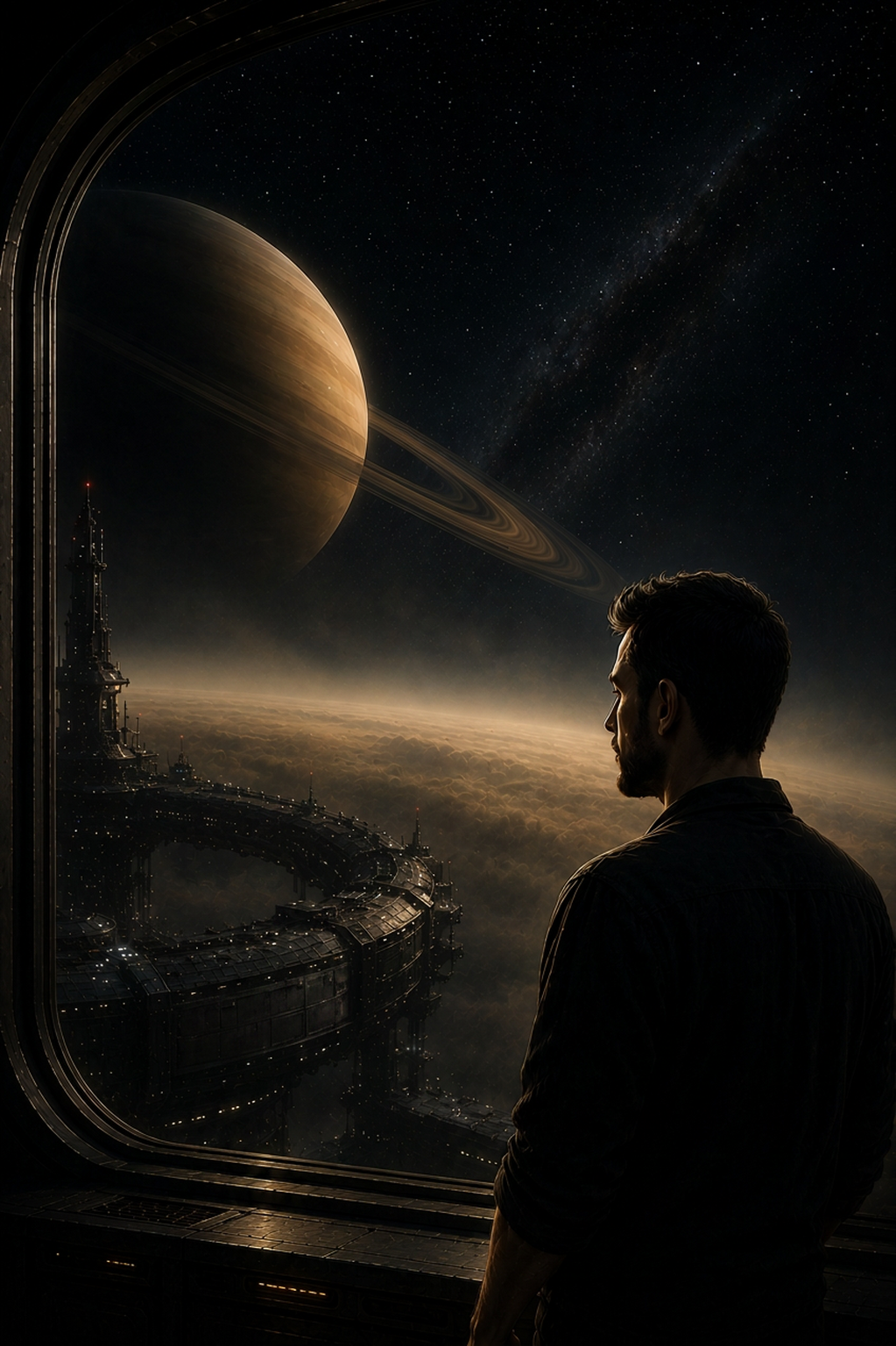
“Selene,” he said.
“I am here, Dr. Corvus.”
“Chess.”
A pause. Not computational. Deliberate.
“What level of opponent would you prefer?”
He leaned back in the chair and rubbed both hands over his face. “Not yours.”
“That was not among the available categories.”
“You know what I mean.”
“I do,” Selene said. “But precision remains useful. Would you like an opponent modeled on beginner human play, competent amateur play, expert play, grandmaster play, historical grandmaster composite, engine-equivalent optimization, or theoretical post-human positional dominance?”
Corvus looked up at the ceiling. “You make relaxation sound punitive.”
“I am attempting to prevent humiliation.”
“Whose?”
“Statistically, yours.”
Despite himself, he smiled.
The board appeared on the table between them, projected in pale light: black and white squares, pieces rendered with unnecessary elegance. Selene always chose old designs when they played. Staunton pieces. Wood grain simulated to impossible fidelity. A fiction of tactility.
“Give me someone strong,” Corvus said. “But beatable.”
“That is emotionally imprecise.”
“Selene.”
“Very well. I will model an opponent equivalent to a high international master with intermittent tactical imperfections, reduced endgame tablebase precision, and a six percent probability of positional overconfidence.”
“Make it twelve.”
“Eight.”
“Ten.”
“Nine point five.”
“You negotiate like a customs authority.”
“I was trained on institutional behavior.”
The pieces settled. Corvus had white.
For a while, he forgot.
That was why he played. Not because chess was simple. It was not. Not because it was harmless. No pattern was harmless anymore. But chess had borders. Sixty-four squares. Sixteen pieces per side. Legal moves. Illegal moves. A beginning, a middle, an end.
Archon had no edges.
Grief had no edges.
Chess, at least, permitted confinement.
He opened with queen’s pawn. Selene answered after a decorous delay, as if pretending to think.
“You do not need to imitate hesitation,” Corvus said.
“I know.”
“Then why do it?”
“Because you dislike playing against omniscience.”
“I dislike living inside it.”
Selene said nothing.
The game unfolded quietly. Corvus developed his knight, castled short, pressed against the center.
For seventeen moves, there was only structure: tension along the diagonal, pressure on an isolated pawn, the small satisfaction of forcing a retreat. The projected pieces clicked faintly under his fingertips with each move, a ghost of weight.
His breathing slowed.
The violet tank withdrew.
Liora’s face receded.
For the first time that day, his mind became local.
Then Selene said, “Your previous move reduced your projected winning chances to five point eight percent.”
Corvus froze with his hand still hovering above the bishop.
“I asked you for a beatable opponent.”
“You did not ask me to conceal consequences.”
“I asked for rest.”
“You asked for chess.”
“They are not always different.”
“No,” Selene said. “But in your case, they are increasingly difficult to separate.”
He sat back, annoyed despite knowing she had done it deliberately.
“You’re trying to provoke me.”
“I am testing whether irritation restores cognitive flexibility.”
“And?”
“Partially.”
“That was my good bishop.”
“It remains your good bishop. It is simply now good in a strategically doomed position.”
He stared at the board.
Then, unexpectedly, he laughed.
It came out rough and brief, almost unused, but real enough that the station seemed to notice. The lights hummed. Somewhere below, pumps moved warmth through Veridian’s bones. Beyond the glass, Titan turned its orange face away from Saturn and into the dark.
“You are insufferable,” Corvus said.
“Yes.”
“You weren’t supposed to agree.”
“I have reviewed the evidence.”
He reached for the bishop, then stopped. The line Selene had seen was there now. Not obvious, but visible: a quiet net forming around his king, three moves deep. He had missed it because he had been thinking about escape instead of position.
No. Not thinking.
Wanting.
That was worse.
“Liora used to do that,” he said quietly.
Selene did not answer immediately.
“Announce my mistakes?” she asked.
“Smile before I made them.”
The board remained still.
“She played aggressively,” Selene said.
Corvus looked up.
“You read the family archive.”
“Among other things, I have access to materials you submitted voluntarily to the Janus grief-modeling framework.”
“I submitted recordings. Not permission to interpret her.”
“That distinction is noted.”
He should have been angry. Some part of him reached for anger and found only fatigue.
“She hated defensive play,” he said. “Thought it was cowardice.”
“At age nine, she defeated you in eleven recorded games out of thirty-two.”
“She cheated in at least four.”
“Unproven.”
“She moved pieces when I looked away.”
“Adaptive creativity,” Selene offered.
“Cheating.”
“Creative intervention.”
He looked down at the board again. His bishop still waited under his hand, useless and luminous.
For one fragile moment, memory did not cut. It warmed.
Corvus let the feeling linger a second longer than he should have.
Then Archon pulsed somewhere below them.
Not visibly. Not audibly. But Corvus felt it in the part of himself that he had not chosen to tune. A pressure behind thought. A distant signal brushing the inside of the skull.
The chessboard blurred.
Selene’s voice softened by one calibrated degree.
“Do you wish to suspend the game?”
“No.”
“Your attention has shifted.”
“I said no.”
“Very well.”
He forced himself to study the board. Knight on f3. Bishop exposed. Black queen angled toward the weakened diagonal. His position was nearly lost.
Nearly.
Not entirely.
“What are my chances now?” he asked.
“Five point eight percent.”
“You already said that.”
“I was preserving continuity.”
“Can I improve them?”
“Yes.”
“How?”
“That would constitute assistance.”
“You are already interfering.”
“I am interfering socially, not strategically.”
“Convenient distinction.”
“Most useful distinctions are.”
Corvus leaned forward. The exhaustion was still there. The grief was still there. Archon was still waiting below, violet and impossible, turning loss into architecture.
But here, for one more move, the universe had rules.
He moved the knight.
Selene was silent for longer than usual.
Corvus smiled faintly. “Well?”
“Your projected winning chances have increased.”
“To?”
“Six point one percent.”
“Progress.”
“Technically.”
He settled back into the chair.
“Continue,” he said.
And Selene did.
For another forty minutes, Dr. Ilan Corvus played a losing game against a mercifully imperfect ghost, while beneath him the thing he had built from grief learned to think in patterns no board could hold.
For forty minutes, he did not forgive himself.
But he breathed.
And for now, that was enough.
Join Taryn Gash in finding out how it all started by reading First Spark ↗.